What you log is your business.
Your clients see polish. Only you see the machine. Won't appear on your LinkedIn — or anyone's.
* It's simple math: If our fee is $29 and we generate an extra $1,123.50 in billables for you, your net profit is $1,094.50. The tool isn't a cost; it's an asset.
Three steps. No fanfare.
Nothing about the process is dramatic. That's rather the point.
- 01FILE // INTAKE
Upload the mess.
CSV, Toggl, Clockify, Harvest — whatever format your week actually happened in. No cleanup required first.
- 02FILE // REVIEW
Approve what changed.
Every rewritten line sits next to the original. Nothing leaves this screen without your yes.
- 03FILE // CLOSE
Export the clean copy.
A client-ready report, timestamped and done. Your working notes stay yours.
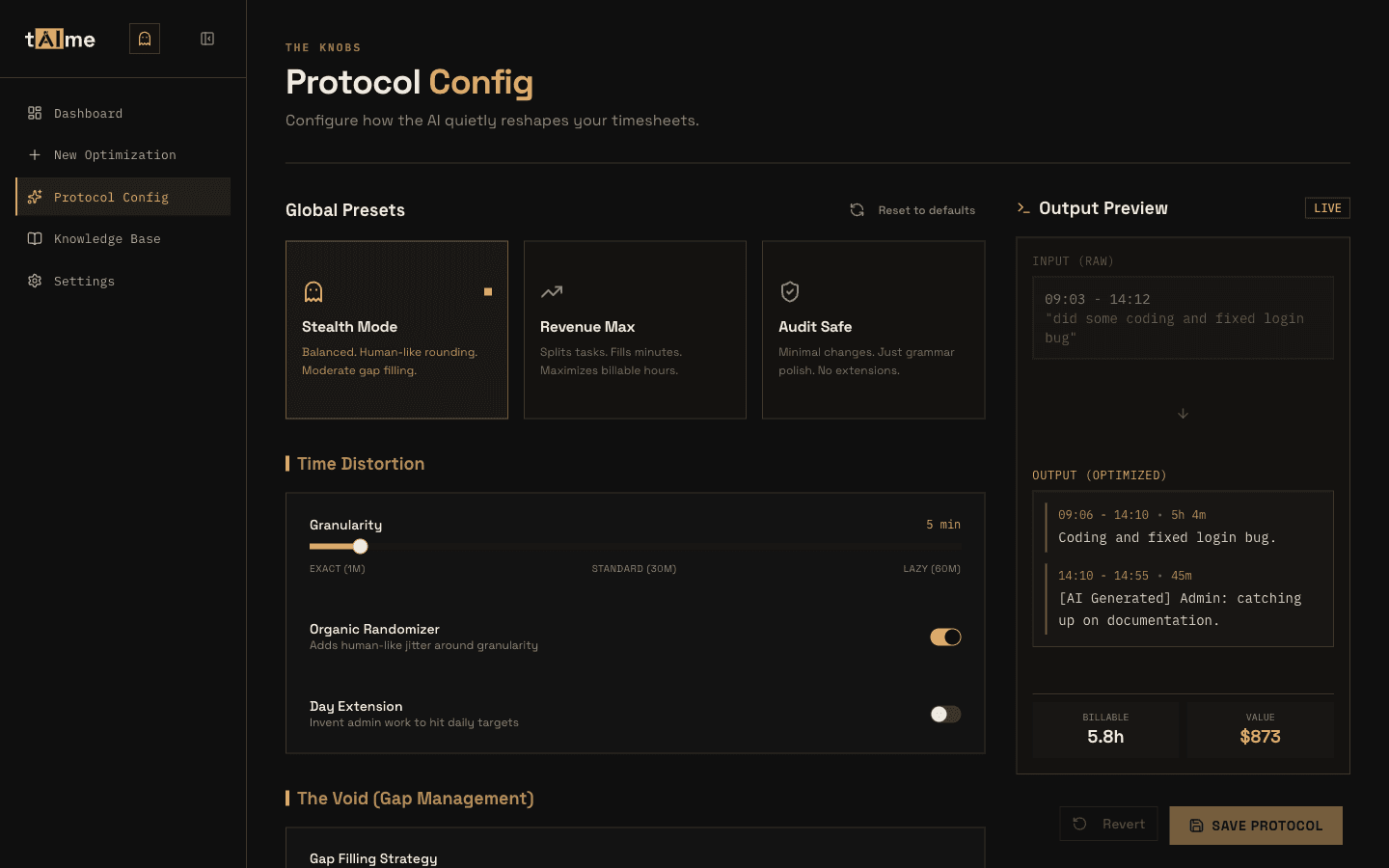
The product, photographed.
No mockups. Screens from a real optimization run — raw shorthand on the left, the version your client sees on the right.
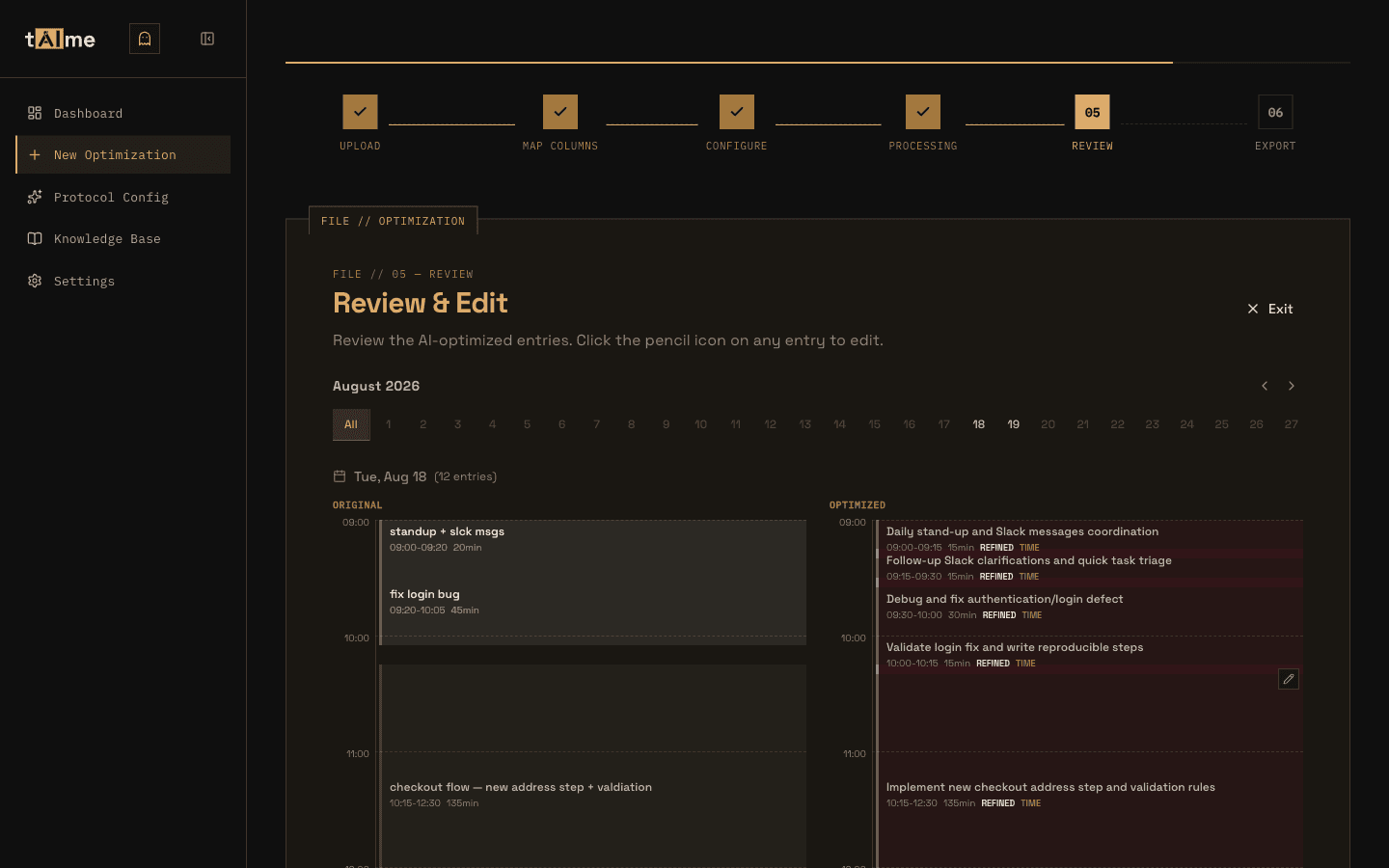
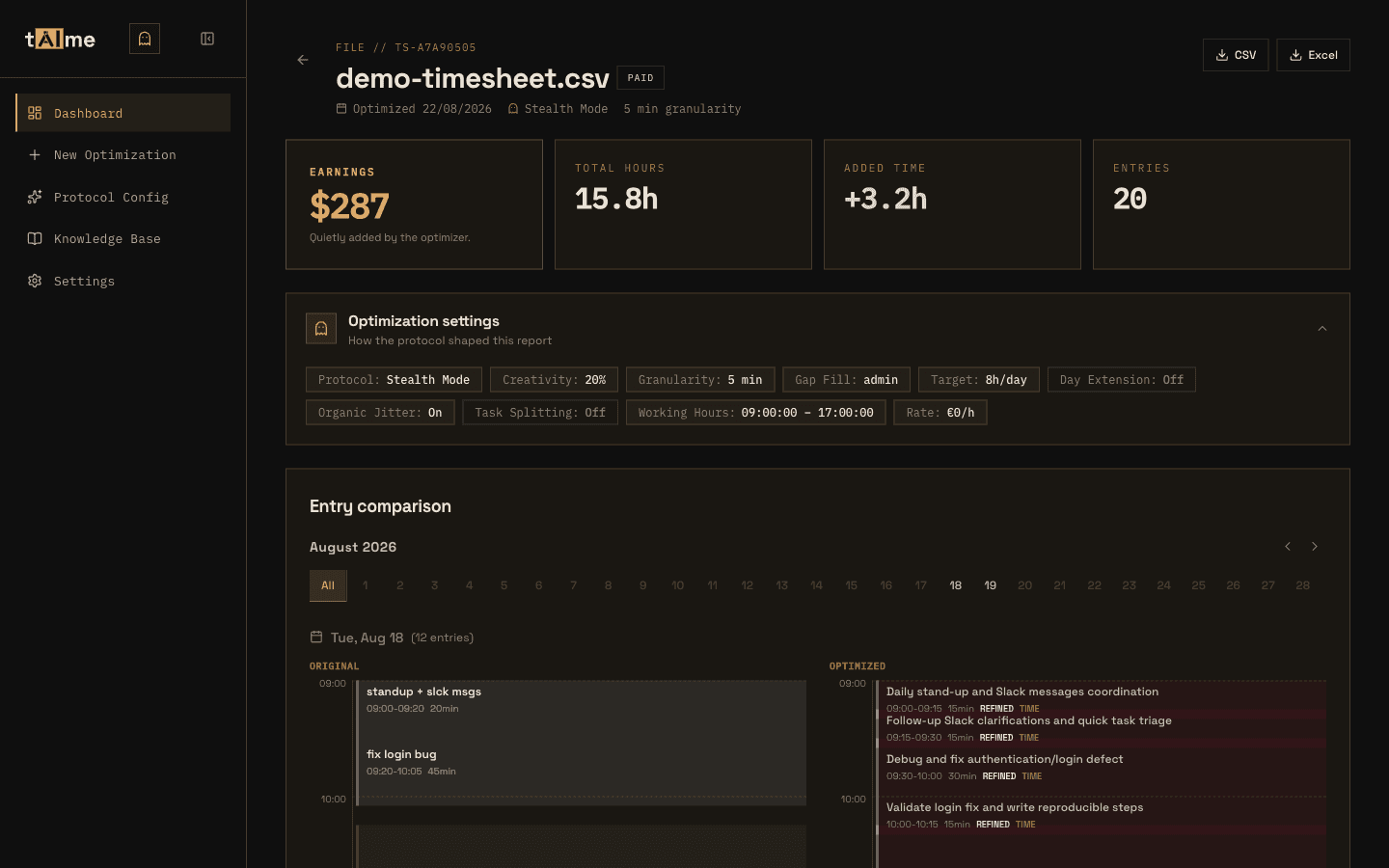
The gap between what you typed and what you send.
Three words scribbled at 6pm become a line a client signs off without a follow-up question. What follows is the actual before and after.
- Same hours you logged. Different sentence describing them.
- Every polished line traces back to what you actually typed.
- Nothing is invented. It's edited.
* Shape of a real transformation, not a promised wording for your entries.
Rules of engagement.
None of this runs on autopilot in the way people assume. Every adjustment below is a setting you switch on, tune, or leave alone — open each file to see exactly what it does.
I log one block — “Development — 5 hours.” What happens to it?
It gets read for its actual shape and divided into the entries that were genuinely in there — architecture review, implementation, debugging, documentation, whatever the work supports. Task Splitting is a setting, not a default: you choose the length a block has to reach before it's split, in Protocol settings, and you can turn it off entirely to keep blocks exactly as logged.
* Proportions follow the work that was actually inside the block — nothing added, only divided.
Will it touch my client meetings and calls?
No — never. Four keywords are locked by default: Meeting, Call, Sync, Lunch. Any entry containing one is left completely alone — same start time, same end time, same wording, no exceptions. Add your own keywords to the lock list in Protocol settings if your calendar uses different shorthand.
* Meeting · Call · Sync · Lunch — locked out of the box. Start, end, wording: untouched.
What happens to the gaps where I took a break or went for coffee?
Gap handling is a protocol setting you choose — it doesn't happen to you by default. Skip the choice and gaps stay exactly as logged. Pick a preset and it follows: Stealth fills gaps with plausible admin work, Revenue fills them more aggressively, Audit leaves them empty. Turn it on and the system finds any gap past your threshold and fills it with a believable entry; whatever the model misses, a deterministic safety net catches before anything is finalized. Filled blocks never overlap a real entry or a locked meeting, and every one lands in your review screen before export — nothing ships without your eyes on it.
* A filled block never overlaps a real entry or a locked meeting, and every fill passes your review before export.
I started late and finished early one day. Can it fix my start and end times?
Only if you ask it to. Day Extension is an opt-in setting, off by default. Turn it on and a short day gets rounded out at the edges with legitimate prep or wrap-up work; leave it off and the day is logged exactly as you gave it to us.
* Opt-in, off by default. Edges only — the core of your day is never moved.
Will the descriptions sound like me?
Only as much as you teach it. The system doesn't study your upload history — there's no learning loop watching what you send it. What it does is apply the vocabulary and phrasing rules you set once, in Protocol and Knowledge settings, the same way on every run. Write down how you actually talk about your work and it holds the line; skip that step and you get a competent, generic default.
* Set once in Protocol & Knowledge settings — applied the same way on every run.
I always round to 15 minutes. Won't minute-perfect billing look out of place?
It won't, because we don't produce it. Time Granularity sets your rounding unit — 15, 30, or 60 minutes, whatever you already bill in — and the Organic Randomizer layers a small, human amount of variation on top of it. The output matches the pattern your clients already expect, not some new artificial precision.
* The rounding unit is yours — the output follows whichever pattern your clients already see.
Do I have to configure any of this by hand?
No. Three presets in the wizard cover most cases out of the box — Stealth (balanced and professional), Revenue Max (surfaces the most billable hours), Audit Safe (minimal changes, easiest to defend). Pick one and you're done; every setting underneath stays open for you to override later.
* Every setting underneath a preset stays open for manual override.
Confirmed. Not claimed.
No quotes, no avatars, no client logos — anyone can fabricate those. Here's what's actually true, and where to check it yourself.
- Integration tokens are encrypted at rest with AES-256-GCM — never logged, never stored in plaintext.
- Row-level security isolates every account's data, enforced by Postgres itself — not application code.
- Your data is never sold. Full stop.
- Delete an upload and it's gone from the database within 7 days; backups age out within 30.
- Operated by a named EU company: R2S, s.r.o., IČO 28130936 — not an anonymous shell.
* Verify any of this yourself in the privacy policy or the imprint.
Do the arithmetic once.
Most tools cost you time and ask you to trust the payoff. This one is priced to survive its own receipt.
* Illustrative shape of the math, not a promised outcome — the ledger is twelve months of the receipt above, varied the way real months vary. Your own number depends on how much you under-describe your hours today.
Clearance levels, not sales tiers.
Same algorithm at every level. What changes is how long you're cleared to run it.
* Positive ROI guarantee: if the optimization doesn't generate additional billable value exceeding your subscription fee within the first month, we will refund 100% of your payment.
Running a consultancy? Multiply the anomaly.
One contractor running this quietly is a rounding error. A whole team is a margin line.
- One operator recovers ~$1,123.50/mo. A team compounds it.
- Same algorithm, applied at whatever scale your roster runs.
- Rolled out quietly — nothing changes in how your team logs time.
Custom bulk protocols and API integration for high-volume reporting entities. Not listed above — not public. Documentation is disclosed on engagement.
* Illustrative — 20× the single-operator recovery figure above. NDAs available on request.
Close this month's file.
Optimize My Timesheet NowNo trial fanfare. No badges. Members know.